

Introduction
One-inch steel pipe, a foundational component in numerous industrial and construction applications, refers to a cylindrical hollow section manufactured from various steel alloys. While nominally designated as “1 inch,” the actual internal diameter (ID) and external diameter (OD) vary based on the pipe’s schedule (wall thickness) and manufacturing standard. This guide provides a comprehensive technical overview of 1-inch steel pipe, encompassing its material science, manufacturing processes, performance characteristics, potential failure modes, and relevant industry standards. Its position within the industry chain is critical, acting as a conduit for fluids, gases, and structural support in sectors including oil and gas, water conveyance, construction, and manufacturing. Core performance parameters include its pressure rating, tensile strength, corrosion resistance, and dimensional accuracy, directly impacting system reliability and operational safety. Understanding these parameters is paramount for engineers, procurement managers, and quality control personnel involved in specifying and utilizing steel pipe systems. The selection of the appropriate steel grade and schedule is dictated by the intended application, fluid characteristics, operating temperature, and pressure requirements.
Material Science & Manufacturing
The primary raw material for 1-inch steel pipe is carbon steel, although alloy steels like chromium-molybdenum (Cr-Mo) steel and stainless steel are frequently employed for enhanced corrosion resistance and high-temperature applications. Carbon steel typically consists of iron with varying carbon content (0.05% to 2.1% by weight). The carbon content dictates the steel’s hardness, strength, and weldability. Other alloying elements, such as manganese, silicon, and phosphorus, are added to modify specific properties. Manufacturing processes primarily involve seamless and welded techniques. Seamless pipe is produced by piercing a solid billet of steel and subsequently drawing it to the desired dimensions. This process yields a pipe with uniform thickness and superior strength. Welded pipe, conversely, is manufactured by rolling a steel plate into a cylindrical shape and welding the seam. Common welding processes include Electric Resistance Welding (ERW), Submerged Arc Welding (SAW), and Laser Beam Welding (LBW). ERW is cost-effective for high-volume production but may exhibit lower strength at the weld seam compared to SAW and LBW. Key parameter control during manufacturing includes precise temperature regulation during heating and cooling, accurate dimensional control through drawing and rolling operations, and rigorous non-destructive testing (NDT) – including ultrasonic testing, radiographic testing, and hydrostatic testing – to detect defects. The heat-affected zone (HAZ) created during welding requires careful monitoring to prevent embrittlement or corrosion. The chemical composition of the steel must conform to specified standards (ASTM, API, etc.) to ensure consistency and predictable performance. Surface finish, achieved through pickling and passivation, enhances corrosion resistance and improves coating adhesion.
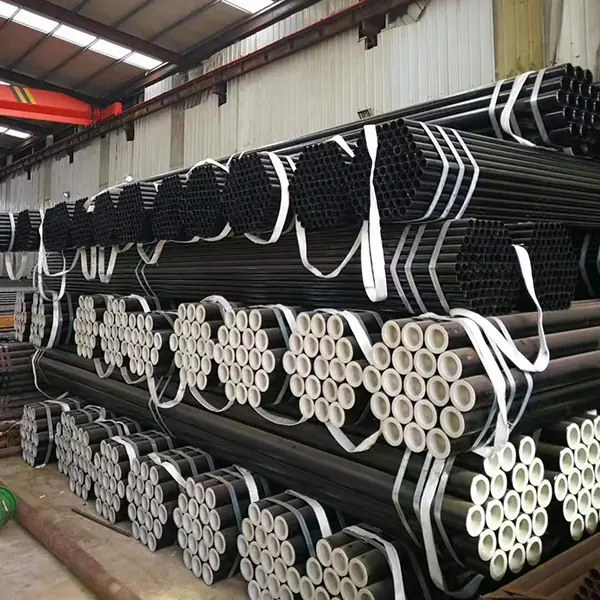
Performance & Engineering
The performance of 1-inch steel pipe is heavily influenced by its mechanical properties, including yield strength, tensile strength, elongation, and impact toughness. Yield strength represents the stress at which the pipe begins to deform permanently, while tensile strength is the maximum stress it can withstand before fracturing. These parameters are critical for determining the pipe’s load-bearing capacity and resistance to collapse under external pressure. Force analysis typically involves calculating hoop stress and longitudinal stress resulting from internal pressure. The Barlow’s formula (S = PD/2t, where S is hoop stress, P is internal pressure, D is outside diameter, and t is wall thickness) provides a fundamental estimate of hoop stress. Environmental resistance is paramount, particularly in corrosive environments. Galvanization, epoxy coatings, and internal linings are commonly employed to mitigate corrosion. Compliance requirements vary based on the application. For pressure vessel applications, ASME Boiler and Pressure Vessel Code Section VIII Division 1 dictates design and manufacturing standards. For oil and gas pipelines, API 5L specifies requirements for line pipe. Furthermore, material traceability and documentation are crucial for ensuring compliance and facilitating quality control. Fatigue analysis is critical for applications involving cyclical loading, as repeated stress can lead to crack initiation and propagation. Proper support and bracing are essential to minimize bending stresses and prevent buckling. Consideration must be given to thermal expansion and contraction, which can induce stresses in the pipe system. The selection of appropriate fittings and joining methods (welding, threading, flanging) also significantly impacts the overall system performance.
Technical Specifications
| Schedule | Outside Diameter (OD) (inches) | Wall Thickness (WT) (inches) | Internal Diameter (ID) (inches) |
|---|---|---|---|
| Schedule 40 | 1.660 | 0.154 | 1.352 |
| Schedule 80 | 1.660 | 0.218 | 1.224 |
| Schedule 160 | 1.660 | 0.280 | 1.080 |
| XS (Extra Strong) | 1.660 | 0.375 | 0.885 |
| STD (Standard) | 1.660 | 0.120 | 1.420 |
| Double Extra Strong (X2) | 1.660 | 0.438 | 0.822 |
Failure Mode & Maintenance
1-inch steel pipe is susceptible to several failure modes. Corrosion, both general and localized (pitting, crevice corrosion, galvanic corrosion), is a primary concern, leading to material loss and eventual leakage. Fatigue cracking can occur under cyclical loading, initiated by stress concentrations at welds or defects. Erosion-corrosion, particularly in systems transporting abrasive fluids, accelerates material degradation. Hydrogen embrittlement, prevalent in high-strength steels exposed to hydrogen sulfide (H2S), reduces ductility and promotes cracking. Stress corrosion cracking (SCC) occurs when tensile stress and a corrosive environment combine. Delamination, specifically in coated pipes, involves the separation of the coating from the substrate. Maintenance strategies include regular visual inspections for signs of corrosion or damage, non-destructive testing (ultrasonic testing, radiographic testing) to detect internal flaws, and periodic hydrostatic testing to verify pressure integrity. Protective coatings should be inspected for damage and repaired promptly. Cathodic protection, utilizing sacrificial anodes or impressed current, can mitigate corrosion in buried pipelines. Proper drainage and ventilation prevent moisture accumulation and reduce the risk of corrosion. Cleaning and descaling remove deposits that can contribute to erosion-corrosion. For welded pipes, regular weld inspections and stress relieving treatments can prevent cracking. Replacement of severely corroded or damaged sections is often necessary to maintain system integrity. Maintaining accurate records of inspections, repairs, and replacements is crucial for tracking pipe condition and predicting future failures.
Industry FAQ
Q: What is the difference between Schedule 40 and Schedule 80 pipe in terms of pressure rating?
A: Schedule 80 pipe has a thicker wall than Schedule 40 pipe, resulting in a significantly higher pressure rating. The increased wall thickness provides greater resistance to hoop stress. While the OD is the same (1.660 inches), the increased WT (0.218” vs 0.154”) allows Schedule 80 to withstand substantially higher internal pressures. Specific pressure ratings depend on the material grade and temperature, but Schedule 80 is typically used in applications requiring higher pressures or greater safety margins.
Q: How does the welding process affect the corrosion resistance of steel pipe?
A: The welding process introduces a Heat Affected Zone (HAZ) which can alter the microstructure of the steel, potentially reducing its corrosion resistance. Improper welding techniques can lead to the formation of carbides, which are susceptible to intergranular corrosion. Furthermore, weld defects such as porosity and slag inclusions can act as initiation sites for corrosion. Using appropriate welding consumables, pre- and post-weld heat treatments, and rigorous inspection procedures are crucial to maintain corrosion resistance.
Q: What is the impact of temperature on the performance of 1-inch steel pipe?
A: Temperature significantly impacts the mechanical properties of steel. Higher temperatures generally reduce yield strength and tensile strength, while increasing ductility. Lower temperatures can lead to brittle fracture, particularly in certain steel grades. Thermal expansion and contraction can induce stresses in the pipe system. Furthermore, the rate of corrosion increases with temperature. Selecting a steel grade appropriate for the operating temperature is essential.
Q: What are the common non-destructive testing (NDT) methods used for inspecting steel pipe?
A: Common NDT methods include ultrasonic testing (UT), which uses sound waves to detect internal flaws; radiographic testing (RT), which uses X-rays or gamma rays to visualize defects; magnetic particle testing (MT), which detects surface and near-surface cracks in ferromagnetic materials; liquid penetrant testing (PT), which reveals surface cracks; and hydrostatic testing, which verifies pressure integrity by subjecting the pipe to high pressure.
Q: What considerations should be made when selecting a coating for 1-inch steel pipe?
A: Coating selection depends on the corrosive environment and operating temperature. Epoxy coatings provide good chemical resistance, while polyurethane coatings offer excellent abrasion resistance. Galvanization provides sacrificial protection against corrosion. The coating must be compatible with the steel substrate and applied correctly to ensure adequate adhesion and coverage. Consideration should also be given to the coating’s resistance to UV radiation and mechanical damage.
Conclusion
One-inch steel pipe remains a critical component across diverse industries due to its robust mechanical properties and cost-effectiveness. A thorough understanding of its material science, manufacturing processes, and performance characteristics is essential for ensuring safe and reliable operation. The selection of the appropriate schedule, steel grade, and protective coating, coupled with adherence to relevant industry standards, is paramount for optimizing performance and preventing premature failure.
Looking forward, advancements in materials science, such as the development of high-strength, corrosion-resistant alloys, and innovative coating technologies, will continue to enhance the longevity and reliability of steel pipe systems. Furthermore, the increasing adoption of digital technologies, including advanced NDT techniques and predictive maintenance algorithms, will enable more efficient and proactive management of pipe infrastructure. Proper implementation of these technologies ensures continuous improvement in the overall safety and efficiency of industrial operations reliant on steel piping.
