
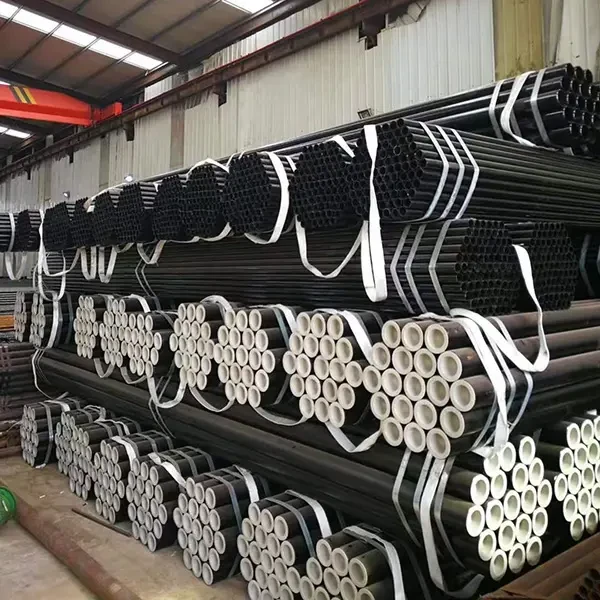
Introduction
Carbon steel square tube is a hollow structural section fabricated from carbon steel, characterized by its square cross-section. Its primary application lies within structural engineering, construction, and various industrial fabrication processes. Positioned as a cost-effective alternative to solid steel bars or more complex hollow sections, the square tube provides a high strength-to-weight ratio. Core performance characteristics include its resistance to bending, torsion, and compression, coupled with weldability and machinability. The material's mechanical properties, determined by its chemical composition and manufacturing process, dictate its suitability for specific load-bearing applications. Understanding its limitations regarding corrosion and fatigue is crucial for ensuring long-term structural integrity. Its usage spans from scaffolding and support structures to vehicle chassis components and agricultural machinery.
Material Science & Manufacturing
Carbon steel square tubes are predominantly manufactured from low-carbon steel grades (typically ASTM A500 Grade B or equivalent). The raw material, hot-rolled carbon steel strip, possesses a chemical composition primarily consisting of iron with varying concentrations of carbon (typically 0.05-0.25%), manganese, silicon, phosphorus, and sulfur. Manganese enhances strength and hardenability, while silicon improves strength and deoxidizes the steel. Phosphorus and sulfur are present as impurities and are controlled to minimize brittleness. The manufacturing process commonly involves cold-forming the steel strip into a square shape, followed by electric resistance welding (ERW) or submerged arc welding (SAW) to create the seam. ERW utilizes high-frequency electric current to heat the edges of the steel, fusing them together under pressure. SAW employs a granular flux to shield the weld pool from atmospheric contamination, resulting in a stronger, more ductile weld. Key parameter control during manufacturing focuses on maintaining precise dimensions (wall thickness, side length), ensuring weld quality (penetration, absence of defects), and achieving desired mechanical properties through heat treatment (normalization or annealing). Surface finish is also critical and commonly includes pickling to remove mill scale and applying protective coatings. Material certifications verifying chemical composition and mechanical properties are essential for quality control and traceability.

Performance & Engineering
The structural performance of carbon steel square tubes is governed by several engineering principles. Bending resistance is directly related to the section modulus, which is influenced by the tube’s outer dimensions and wall thickness. Torsional resistance depends on the torsional constant, and is comparatively lower than bending resistance. Compression performance is affected by the potential for buckling, which is mitigated by increasing wall thickness and reducing unsupported length. A critical aspect of engineering design involves calculating allowable stresses based on the steel's yield strength and ultimate tensile strength, incorporating appropriate safety factors. Environmental resistance considerations include corrosion protection, particularly in outdoor applications. Galvanizing, painting, or applying epoxy coatings are common methods to prevent rust formation. Fatigue performance is essential in applications involving cyclic loading. Stress concentration at weld seams and corners necessitates careful design and welding procedures to maximize fatigue life. Compliance requirements often dictate adherence to specific building codes (e.g., AISC in the USA, Eurocode 3 in Europe) and industry standards, ensuring structural integrity and safety. Force analysis includes Finite Element Analysis (FEA) to accurately predict stress distributions under various loading conditions. This is paramount in critical applications requiring high reliability.
Technical Specifications
| Parameter | ASTM A500 Grade B | EN 10210-2 S235JRH | GB/T 6725-2008 Q235B |
|---|---|---|---|
| Yield Strength (MPa) | 250 | 235 | 235 |
| Ultimate Tensile Strength (MPa) | 450 | 360-510 | 490-630 |
| Elongation (%) | 20 | 16 | 20 |
| Wall Thickness Range (mm) | 1.0 - 12.7 | 1.0 – 8.0 | 1.0 – 12.0 |
| Outer Dimension Range (mm) | 10x10 – 300x300 | 10x10 – 400x400 | 10x10 – 600x600 |
| Corrosion Resistance | Low (requires coating) | Low (requires coating) | Low (requires coating) |
Failure Mode & Maintenance
Carbon steel square tubes are susceptible to several failure modes in practical applications. Corrosion is a primary concern, leading to rust formation and section loss, weakening the structure over time. This is particularly prevalent in humid or corrosive environments. Fatigue cracking can occur under cyclic loading, initiating at stress concentration points such as weld seams or corners, ultimately leading to catastrophic failure. Buckling is a concern in compression members, particularly if unsupported lengths are excessive or wall thickness is insufficient. Denting or impact damage can reduce load-carrying capacity and create stress raisers. Weld defects, such as porosity or incomplete fusion, can compromise structural integrity. Maintenance strategies involve regular inspection for corrosion, cracks, and dents. Protective coatings should be reapplied as needed. Weld seams should be periodically examined using non-destructive testing methods (e.g., ultrasonic testing, radiography). For heavily loaded structures, periodic load testing may be necessary to verify structural integrity. Prompt repair of any identified damage is crucial to prevent further deterioration and ensure long-term safety. Cleaning to remove debris and contaminants also aids in identifying early-stage corrosion.
Industry FAQ
Q: What is the primary difference between ERW and SAW welded square tubes, and how does it affect the application?
A: ERW (Electric Resistance Welding) is a faster, more cost-effective process suitable for lighter-duty applications. SAW (Submerged Arc Welding) provides a stronger, more ductile weld with better penetration, making it ideal for heavier structural loads and applications requiring high weld integrity. SAW tubes generally command a higher price point but offer superior performance in demanding environments.
Q: How does the carbon content in the steel affect the weldability of the square tube?
A: Higher carbon content generally reduces weldability, increasing the risk of cracking during welding. Low-carbon steels (like those used for A500 Grade B) are more readily weldable, requiring less preheating and post-weld heat treatment. Excessive carbon increases hardness, making the weld zone more susceptible to brittle fracture.
Q: What galvanizing standards should I look for to ensure adequate corrosion protection?
A: The primary galvanizing standard is ASTM A123 for hot-dip galvanized steel products. Ensure the galvanizing process meets or exceeds this standard for coating thickness and uniformity. ISO 1461 is the international equivalent. Look for a minimum zinc coating thickness of 55 micrometers for general outdoor applications.
Q: How important is dimensional tolerance in carbon steel square tubes, and what tolerances are typically acceptable?
A: Dimensional tolerances are critical, especially in applications requiring precise fit-up and assembly. Typical tolerances for square tube dimensions are ±0.5mm to ±2mm, depending on the specific standard and manufacturing process. Tighter tolerances may require more stringent quality control and increased manufacturing costs.
Q: What is the impact of heat treatment (e.g., normalizing) on the mechanical properties of carbon steel square tube?
A: Heat treatment, such as normalizing, refines the grain structure of the steel, improving its strength, toughness, and ductility. It also relieves residual stresses introduced during manufacturing. Normalizing enhances the overall mechanical properties and improves the steel's response to subsequent forming or machining operations.
Conclusion
Carbon steel square tube represents a versatile and cost-effective structural component widely utilized across numerous industries. Its performance characteristics, dictated by its material composition, manufacturing processes, and engineering design, are fundamental to its safe and reliable application. A comprehensive understanding of potential failure modes, coupled with proactive maintenance strategies, is crucial for maximizing service life and ensuring structural integrity.
The selection of appropriate standards (ASTM, EN, GB) and adherence to relevant building codes are paramount. Future developments may focus on advanced coating technologies to enhance corrosion resistance and the integration of high-strength steel alloys for applications demanding greater load-bearing capacity. Continuous improvement in welding techniques and non-destructive testing methods will further elevate the quality and reliability of carbon steel square tube structures.
